🧭 HDIP: AI Product PDEP Stages
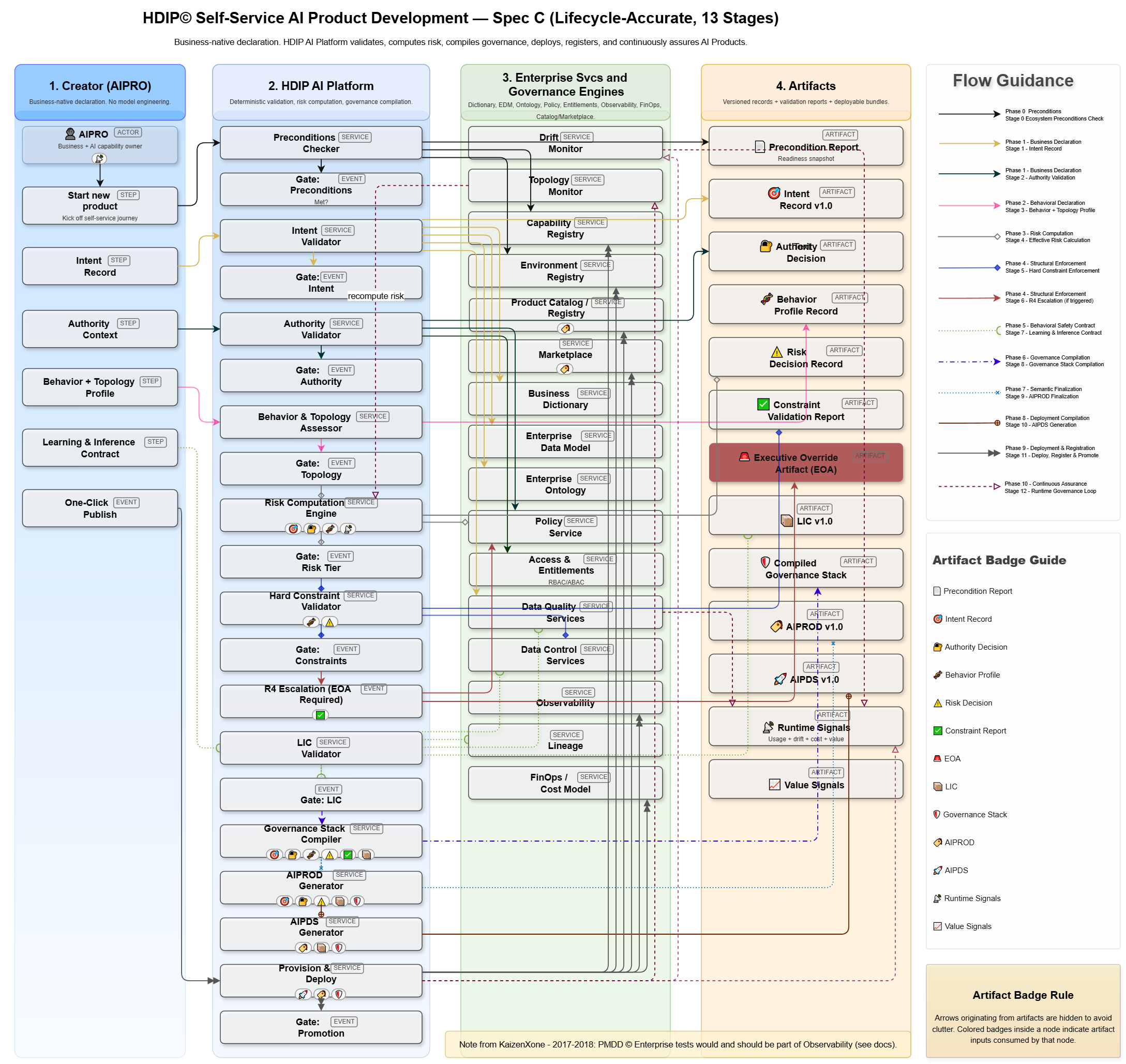
🧭 HDIP: AI Product PDEP Stages - Detailed Stage by Stage
🔴 Stage 0 — Preconditions
| Row Heading | Stage 0 Definition |
|---|---|
| Stage Number | 0 |
| Stage Name | Preconditions |
| Lifecycle Phase | Preconditions |
| Purpose | Ensure the enterprise AI ecosystem is ready for AI product creation |
| Outcome | Verified availability of capabilities, environments, and governance services |
| Context | Occurs before any AI product-specific activity |
| Scope | Capability registry, environment registry, governance engines readiness |
| Primary Inputs | Enterprise registries, platform capabilities |
| External Dependencies | Capability Registry, Environment Registry |
| Core Activities | Validate compute availability, runtime environments, governance services |
| Processing Type | Platform-driven |
| Output Artifacts | Precondition Report |
| State Transition | From “No readiness” → “AI product creation possible” |
| Governance Controls | Platform readiness policies |
| Validation Mechanisms | Registry validation checks |
| AIPRO Responsibility | None |
| Platform Responsibility | Validate readiness |
| Quality Sensitivity | High |
| Failure Modes / Risks | Missing capabilities, unavailable environments |
| Observability Signals | Registry completeness |
| Feedback Loop | Platform enablement |
🔴 Stage 1 — Intent Record
| Row Heading | Stage 1 Definition |
|---|---|
| Stage Number | 1 |
| Stage Name | Intent Record |
| Lifecycle Phase | Business Declaration |
| Purpose | Define the purpose, audience, and value of the AI product |
| Outcome | Formal AI Intent Record |
| Scope | Business-level definition only |
| Primary Inputs | Business need |
| External Dependencies | None |
| Core Activities | Define purpose, use case, expected outcomes |
| Processing Type | Human-driven |
| Output Artifacts | Intent Record |
| State Transition | Idea → Defined AI intent |
| Governance Controls | Intent clarity |
| Validation Mechanisms | Completeness checks |
| AIPRO Responsibility | Define intent |
| Platform Responsibility | Validate structure |
| Quality Sensitivity | Critical |
🔴 Stage 2 — Authority Confirmation
| Row Heading | Stage 2 Definition |
|---|---|
| Stage Number | 2 |
| Stage Name | Authority Confirmation |
| Purpose | Validate ownership and accountability |
| Outcome | Authorized AI Product Owner |
| External Dependencies | Identity systems |
| Core Activities | Validate ownership |
| Output Artifacts | Authority Decision |
| Risks | Unauthorized creation |
🔴 Stage 3 — Behavior & Topology Profile
| Row Heading | Stage 3 Definition |
|---|---|
| Stage Number | 3 |
| Stage Name | Behavior & Topology Profile |
| Purpose | Define AI behavior and deployment topology |
| Outcome | Behavior Profile Record |
| Scope | Decision logic, autonomy level, topology |
| Core Activities | Define agent behavior, topology scope |
| Output Artifacts | Profile Record |
| Risks | Incorrect scope leading to risk amplification |
🔴 Stage 4 — Risk Computation
| Row Heading | Stage 4 Definition |
|---|---|
| Stage Number | 4 |
| Stage Name | Effective Risk Tier |
| Purpose | Compute AI risk level (R0–R4) |
| Outcome | Risk Decision Record |
| Core Activities | Evaluate risk dimensions |
| Output Artifacts | Risk Tier |
| Governance Controls | Risk policies |
| Risks | Under/over classification |
🔴 Stage 5 — Structural Constraints & Escalation
| Row Heading | Stage 5 Definition |
|---|---|
| Stage Number | 5 |
| Stage Name | Constraint Enforcement |
| Purpose | Enforce hard governance constraints |
| Outcome | Constraint Validation Report |
| Core Activities | Validate against policy rules |
| Output Artifacts | Constraint Report |
| Failure Modes | Constraint violation |
| Special Case | R4 → Executive Override Artifact (EOA) required |
🔴 Stage 6 — Learning & Inference Contract (LIC)
| Row Heading | Stage 6 Definition |
|---|---|
| Stage Number | 6 |
| Stage Name | LIC |
| Purpose | Define AI behavioral safety contract |
| Outcome | LIC v1.0 |
| Scope | Training, inference, guardrails |
| Core Activities | Define data usage, inference rules |
| External Dependencies | Data Quality, Lineage, Data Control |
| Output Artifacts | LIC |
| Risks | Unsafe AI behavior |
🔴 Stage 7 — Governance Compilation
| Row Heading | Stage 7 Definition |
|---|---|
| Stage Number | 7 |
| Stage Name | Governance Compilation |
| Purpose | Compile policies into executable governance |
| Outcome | Governance Stack |
| Core Activities | Compile policies, entitlements |
| Output Artifacts | Governance Stack |
| Processing Type | Fully automated |
🔴 Stage 8 — AIPROD Finalization
| Row Heading | Stage 8 Definition |
|---|---|
| Stage Number | 8 |
| Stage Name | AIPROD Finalization |
| Purpose | Finalize semantic definition of AI product |
| Outcome | AIPROD v1.0 |
| Scope | Semantic + governance metadata |
| Core Activities | Generate AIPROD |
| Output Artifacts | AIPROD |
| Key Principle | No deployment yet |
🔴 Stage 9 — AIPDS Generation
| Row Heading | Stage 9 Definition |
|---|---|
| Stage Number | 9 |
| Stage Name | AIPDS Generation |
| Purpose | Define deployable blueprint |
| Outcome | AIPDS v1.0 |
| Scope | Deployment specification |
| Core Activities | Generate deployment spec |
| Output Artifacts | AIPDS |
| Key Principle | Still not deployed |
🔴 Stage 10 — Deployment & Registration
| Row Heading | Stage 10 Definition |
|---|---|
| Stage Number | 10 |
| Stage Name | Deployment & Registration |
| Purpose | Deploy and register AI product |
| Outcome | Running AI Product + Catalog Entry |
| Scope | Deployment + ecosystem integration |
| Core Activities | Deploy runtime, register product |
| External Dependencies | Catalog, Marketplace, Capability Registry |
| Output Artifacts | Registered AI Product |
| State Transition | Design → Live Product |
| Key Principle | First moment product becomes visible |
🔴 Stage 11 — Continuous Assurance
| Row Heading | Stage 11 Definition |
|---|---|
| Stage Number | 11 |
| Stage Name | Continuous Assurance |
| Purpose | Monitor runtime behavior |
| Outcome | Signals + Feedback |
| Scope | Drift, usage, cost, value |
| Core Activities | Monitor, evaluate, feedback |
| Output Artifacts | Runtime Signals |
| Feedback Loop | Back to AIPRO |
HDIP AI Product PDEP Spec C Glossary
This glossary defines the key terms used in the HDIP Self-Service AI Product Development / Product Development and Evolution Process (SSPD / PDEP) Spec C flow.
Spec C is the lifecycle-accurate view of how an AI Product Owner (AIPRO) declares business-native AI product intent and how the HDIP AI Platform validates, assesses risk, governs, compiles, deploys, registers, observes, and continuously assures the resulting AI Product.
Access & Entitlements
The enterprise service responsible for managing who or what may access an AI Product, AI Product capability, endpoint, inference surface, data dependency, or governed runtime interface.
In the AI Product PDEP flow, Access & Entitlements supports authority validation, policy evaluation, runtime access control, and governed product consumption.
AI Product
A governed, discoverable, deployable, observable, and lifecycle-managed product that provides AI-enabled capability.
An AI Product may include models, agents, inference services, decision services, AI workflows, embeddings, classifiers, recommenders, generative capabilities, or other AI enabled product forms. In HDIP, an AI Product is not merely a model artifact; it is a governed product with intent, authority, behavior, risk, safety, deployment, trust, observability, and lifecycle controls.
AI Product Owner
See AIPRO.
AIPDS
AI Product Deployment Specification.
AIPDS is the platform-facing deployable specification for an AI Product. It describes how the AI Product should be provisioned, deployed, configured, governed, monitored, and operated.
In the Spec C flow, AIPDS is generated after AIPROD finalization and before deployment.
AIPDS Generation
The deployment-compilation stage where the HDIP AI Platform generates the deployable AI Product specification.
AIPDS generation translates finalized AI Product semantics, governance stack, behavioral constraints, deployment requirements, and runtime posture into a platform-facing deployment artifact.
AIPDS Generator
The HDIP AI Platform service responsible for generating the AIPDS artifact.
It converts the finalized AIPROD and compiled governance context into a deployable AI Product specification.
AIPRO
AI Product Owner.
The AIPRO is the accountable owner of an AI Product’s business purpose, intended behavior, authority context, acceptable use, lifecycle expectations, and value posture. In HDIP, the AIPRO declares product intent and behavioral expectations in business-native terms and does not need to perform model engineering.
AIPROD
AI Product semantic descriptor.
AIPROD is the marketplace-ready product descriptor for an AI Product. It captures the product’s meaning, purpose, behavioral summary, governance posture, risk tier, usage context, trust metadata, and publication-ready semantic identity.
In HDIP, AIPROD is a semantic and governance-facing artifact, distinct from AIPDS, which is deployment-facing.
AIPROD Finalization
The stage where the HDIP AI Platform finalizes the AI Product’s semantic descriptor after governance compilation.
AIPROD finalization produces a versioned AI Product descriptor that can be registered, discovered, trusted, and published.
AIPROD Generator
The HDIP AI Platform service that produces the finalized AIPROD artifact.
It uses the compiled governance stack, intent, authority context, behavioral profile, risk decision, constraints, and safety contract to create the AI Product’s semantic product descriptor.
Authority Context
The AIPRO-declared context describing the mandate, role, business accountability, and authority under which the AIPRO is creating or publishing the AI Product.
Authority Context helps determine whether the AIPRO has the right to define, govern, deploy, or expose the AI Product.
Authority Decision
A versioned artifact recording the outcome of authority validation.
It captures whether the AIPRO has sufficient mandate to proceed and may include evidence, conditions, restrictions, escalation requirements, or failed validation reasons.
Authority Validation
The lifecycle stage where the HDIP AI Platform validates whether the AIPRO has the mandate and accountability required to create or publish the AI Product.
Authority validation checks ownership, business accountability, organizational mandate, and entitlement context.
Authority Validator
The HDIP AI Platform service that performs authority validation.
It may consult policy services, access and entitlement systems, organizational-role context, and product ownership rules.
Behavior & Topology Assessor
The HDIP AI Platform service that evaluates the declared behavior and topology of the AI Product.
It assesses characteristics such as autonomy, topology scope, authority scope, control mode, human oversight, interaction pattern, and agentic behavior.
Behavior + Topology Profile
The AIPRO-declared behavioral and structural profile of the AI Product.
It describes what kind of AI Product is being created, how it behaves, what topology it operates in, what degree of autonomy it has, and what control or oversight model applies.
Behavior Profile Record
A versioned artifact produced by the Behavior & Topology Assessor.
It captures the normalized behavioral profile of the AI Product and becomes an input to risk computation, governance compilation, and runtime assurance.
Behavioral Declaration
The lifecycle phase where the AIPRO declares the behavioral nature of the AI Product.
This includes topology, autonomy, control mode, authority scope, and behavioral expectations.
Behavioral Safety Contract
The lifecycle phase where the AIPRO declares or confirms the learning, inference, safety, and usage constraints of the AI Product.
In this flow, the Behavioral Safety Contract is represented by the Learning & Inference Contract (LIC).
Business Declaration
The lifecycle phase where the AIPRO declares product intent and authority context.
Business Declaration establishes what the AI Product is for and whether the AIPRO has the mandate to proceed.
Business Dictionary
An enterprise service containing approved business terms, definitions, vocabularies, synonyms, and semantic standards.
In the AI Product PDEP flow, the Intent Validator uses the Business Dictionary to ground AI Product intent in enterprise language.
Capability Registry
An enterprise registry describing available platform, AI, deployment, governance, and runtime capabilities.
The Preconditions Checker and Deployer use the Capability Registry to determine whether the platform can support the AI Product’s creation, deployment, and operation.
Catalog
See Product Catalog / Registry.
Compiled Governance Stack
A versioned artifact generated by the Governance Stack Compiler.
It contains the compiled governance controls, policies, entitlements, risk constraints, safety requirements, monitoring obligations, and runtime control posture required for the AI Product.
Constraint Validation Report
A versioned artifact produced by the Hard Constraint Validator.
It records whether structural constraints, risk constraints, control requirements, policy requirements, and mandatory safeguards have been satisfied.
Continuous Assurance
The lifecycle phase where the deployed AI Product is monitored, evaluated, and governed continuously.
Continuous assurance includes drift monitoring, topology monitoring, runtime signal generation, risk recomputation, value monitoring, feedback loops, and product evolution.
Cost Model
See FinOps / Cost Model.
Data Control Services
Enterprise services that support control enforcement, data-use controls, policy enforcement, runtime restrictions, and governance checks.
In the AI Product PDEP flow, Data Control Services are used by the Hard Constraint Validator and LIC Validator to ensure that AI Product behavior and usage are constrained appropriately.
Data Quality Services
Enterprise services that support quality checks, validation, data fitness, training or inference data suitability, monitoring, and runtime signal generation.
In the AI Product PDEP flow, Data Quality Services help validate intent, support LIC validation, and contribute runtime quality signals.
DC Services
See Data Control Services.
Deploy, Register & Promote
The lifecycle stage where one-click publish triggers deployment, registration, observability configuration, cost model integration, catalog update, marketplace exposure, and promotion gating.
This stage materializes the AI Product into a governed operational product.
Deployer
The HDIP AI Platform service responsible for provisioning and deploying the AI Product.
It interacts with the Capability Registry, Environment Registry, Product Catalog / Registry, Marketplace, Observability, and FinOps / Cost Model services.
Deployment & Registration
The lifecycle phase where the AI Product is provisioned, deployed, registered, and promoted.
This phase connects the generated AIPDS to operational runtime and publishes the product into the enterprise product ecosystem.
Deployment Compilation
The lifecycle phase where the platform generates the deployment-facing artifact for the AI Product.
In this flow, Deployment Compilation produces AIPDS v1.0.
Drift Monitor
An enterprise assurance service that monitors runtime drift in an AI Product.
Drift may include model drift, data drift, behavior drift, performance drift, topology drift, or risk-relevant change in operational conditions.
DQ Services
See Data Quality Services.
Effective Risk Calculation
The lifecycle stage where the HDIP AI Platform computes the AI Product’s effective risk posture.
The calculation uses behavior, topology, authority, intended use, control mode, policy constraints, and other governance factors to produce a Risk Decision Record.
Enterprise Data Model
The enterprise model of core business entities, relationships, structures, and canonical data concepts.
In the AI Product PDEP flow, the Intent Validator uses the Enterprise Data Model to align AI Product intent with enterprise data semantics.
Enterprise Ontology
The enterprise semantic model or knowledge graph describing concepts, relationships, taxonomies, meanings, and domain structures.
In the AI Product PDEP flow, the Intent Validator uses the Enterprise Ontology to ground product intent and reduce semantic ambiguity.
Enterprise Services and Governance Engines
The shared enterprise capabilities used by the HDIP AI Platform to validate, govern, deploy, register, observe, and assure AI Products.
Examples include Business Dictionary, Enterprise Data Model, Enterprise Ontology, Policy Service, Access & Entitlements, Data Quality Services, Data Control Services, Observability, Lineage, Marketplace, Product Catalog / Registry, Capability Registry, Environment Registry, and FinOps / Cost Model.
Environment Registry
An enterprise registry describing deployment environments, runtime zones, residency contexts, infrastructure targets, and environment readiness.
The Preconditions Checker and Deployer use the Environment Registry to verify readiness and route deployment appropriately.
EOA
Executive Override Artifact.
EOA is a formal artifact required when an AI Product triggers R4 escalation and executive-level override or approval is needed.
Executive Override Artifact
See EOA.
FinOps / Cost Model
The enterprise service responsible for cost attribution, economic accountability, cost optimization, showback, chargeback, budget control, and operating-cost visibility.
In the AI Product PDEP flow, the Deployer integrates with FinOps / Cost Model during deployment and continuous assurance.
Gate: Authority
A deterministic validation gate that determines whether the AIPRO has sufficient authority to proceed.
The gate may return pass, conditional, or fail outcomes.
Gate: Constraints
A deterministic validation gate that determines whether mandatory structural, behavioral, policy, and control constraints are satisfied.
It may trigger R4 escalation when high-risk conditions require executive override.
Gate: Intent
A deterministic validation gate that determines whether the Intent Record is complete, coherent, semantically grounded, and suitable for further lifecycle progression.
Gate: LIC
A deterministic validation gate that determines whether the Learning & Inference Contract is valid, enforceable, and compatible with governance expectations.
Gate: Preconditions
A deterministic validation gate that determines whether the ecosystem is ready for AI Product creation.
It checks capability readiness, environment readiness, and availability of required platform and governance services.
Gate: Promotion
A deterministic validation gate that determines whether the deployed AI Product can be promoted to an operational, registered, or published state.
It may consider policy, observability, cost, runtime controls, safety, and deployment success.
Gate: Risk Tier
A deterministic validation gate that determines whether the computed risk tier permits progression, requires controls, or triggers escalation.
Gate: Topology
A deterministic validation gate that determines whether the AI Product’s behavior and topology profile is structurally valid and governable.
Governance Compilation
The lifecycle phase where validated AI Product declarations and risk decisions are compiled into an enforceable governance stack.
The output is the Compiled Governance Stack.
Governance Stack Compiler
The HDIP AI Platform service that compiles policy, entitlement, risk, safety, data quality, data control, authority, and behavioral constraints into a coherent governance stack.
Hard Constraint Enforcement
The lifecycle stage where the platform validates mandatory structural constraints before allowing the product to proceed.
This may include prohibited topology, unacceptable autonomy, missing oversight, invalid policy posture, missing control obligations, or risk-tier-specific restrictions.
Hard Constraint Validator
The HDIP AI Platform service that validates mandatory constraints for AI Product development.
It produces the Constraint Validation Report and may trigger R4 escalation if constraints cannot be satisfied without executive override.
HDIP
Holistic Data & Information Platform.
HDIP is the architecture that enables governed creation, deployment, discovery, consumption, observability, and evolution of Data Products, AI Products, and other product types.
HDIP AI Platform
The AI-specific productization layer within HDIP.
It validates AI Product intent, computes risk, compiles governance, generates AIPROD and AIPDS, provisions deployment, registers the product, and continuously assures runtime behavior.
Intent Record
A versioned artifact capturing the AIPRO’s declared AI Product intent.
It describes product purpose, business value, expected behavior, consumer context, domain context, intended use, and other business-native framing required for validation and governance.
Intent Validator
The HDIP AI Platform service that validates, normalizes, and semantically grounds the AI Product’s Intent Record.
It consults Data Quality Services, Business Dictionary, Enterprise Ontology, and Enterprise Data Model as needed.
Learning & Inference Contract
A behavioral safety contract describing how the AI Product learns, infers, uses data, responds to inputs, operates under constraints, and satisfies safety expectations.
It may cover learning boundaries, inference modes, data suitability, explainability, lineage, monitoring, control requirements, and prohibited behavior.
LIC
Learning & Inference Contract.
LIC is the artifact that captures the AI Product’s behavioral safety and runtime inference contract. It becomes a key input to governance compilation, deployment, and continuous assurance.
LIC Validator
The HDIP AI Platform service that validates the Learning & Inference Contract.
It checks data quality expectations, lineage requirements, control requirements, safety obligations, and enforceability of the contract.
Lineage
The enterprise service that captures relationships among AI Product intent, inputs, data dependencies, models, training data, inference traces, deployment artifacts, governance artifacts, and runtime outputs.
Lineage supports traceability, auditability, governance, risk analysis, and trust.
Marketplace
The enterprise product marketplace where AI Products can be discovered, evaluated, acquired, and consumed.
In the AI Product PDEP flow, deployment and registration expose the AI Product to the Marketplace.
Observability
The enterprise capability that makes AI Product runtime behavior, usage, drift, cost, value, risk posture, incidents, and assurance signals visible.
In continuous assurance, Observability supports monitoring, governance, feedback, and evolution.
One-Click Publish
The AIPRO-facing action that triggers deployment, registration, promotion, and operationalization of the AI Product.
One-click publish does not bypass governance. It activates a governed automated deployment and registration process after required validation stages have completed.
Policy Service
The enterprise service that stores, evaluates, and exposes executable policies.
In the AI Product PDEP flow, the Policy Service participates in authority validation, risk computation, constraint enforcement, escalation, and governance compilation.
Precondition Report
An artifact produced by the Preconditions Checker.
It records whether required capabilities, environments, platform services, registries, and governance engines are available before AI Product creation proceeds.
Preconditions Checker
The HDIP AI Platform service that verifies ecosystem readiness before product creation begins.
It checks Capability Registry, Environment Registry, and other required platform conditions.
Product Catalog / Registry
The enterprise system of record for product metadata, identity, registration, lifecycle state, semantic descriptors, and discoverability.
For AI Products, the Product Catalog / Registry stores or references AIPROD and related registration metadata.
Productization
The lifecycle movement from governed AI Product declaration to deployable, registered, discoverable, and observable product.
In this flow, productization includes AIPROD generation, AIPDS generation, deployment, catalog registration, marketplace exposure, and continuous assurance.
Provision & Deploy
The HDIP AI Platform service that materializes the AI Product into a runtime environment.
It provisions infrastructure, deployment configuration, runtime controls, observability hooks, cost tracking, registry updates, and marketplace publication as required.
R4
The highest or critical risk tier in the AI Product risk model.
An R4 AI Product requires escalation, executive override, or additional governance handling before progression.
R4 Escalation
A critical escalation path triggered when the AI Product’s risk or constraint posture requires executive-level review or override.
In the flow, R4 Escalation produces or requires an Executive Override Artifact.
Risk Computation Engine
The HDIP AI Platform service that computes the AI Product’s risk posture.
It uses behavior and topology profile, policy context, authority context, control requirements, and other governance inputs to produce the Risk Decision Record.
Risk Decision Record
A versioned artifact recording the outcome of risk computation.
It may include the effective risk tier, rationale, controls required, escalation state, and conditions for lifecycle progression.
Runtime Governance Loop
The continuous assurance stage where runtime signals, drift monitoring, topology monitoring, data quality signals, risk recomputation, value signals, and feedback loops keep the AI Product governed after deployment.
Runtime Signals
A runtime artifact containing product assurance signals such as usage, drift, cost, value, DQ signals, compliance indicators, topology changes, and risk-relevant telemetry.
Runtime Signals drive continuous assurance, value monitoring, risk recomputation, and AIPRO evolution.
Semantic Finalization
The lifecycle phase where the AI Product’s marketplace-ready semantic descriptor is finalized.
In the flow, this produces AIPROD v1.0.
SSPD
Self-Service Product Development.
SSPD is the HDIP approach where a product owner declares intent, behavior, governance, and usage expectations in business terms while the platform performs validation, compilation, deployment, registration, and continuous assurance.
Start New Product
The step that is facing the AIPRO, initiates the self-service AI Product creation journey.
It triggers precondition checks before detailed declaration begins.
Structural Enforcement
The lifecycle phase where mandatory structural, behavioral, policy, control, and risk constraints are enforced before the product can proceed.
It prevents invalid or unsafe AI Product designs from moving into governance compilation or deployment.
Topology Monitor
An enterprise assurance service that monitors runtime topology behavior.
It detects changes in interaction patterns, autonomy, tool usage, dependency structure, control mode, or deployment topology that may require risk recomputation.
Value Signals
Artifacts representing the value or outcome contribution of the AI Product.
Value Signals may include model uplift, operational efficiency, decision quality, business impact, consumer satisfaction, automation benefit, cost-to-value (CTV) ratio, or other value indicators for the product.